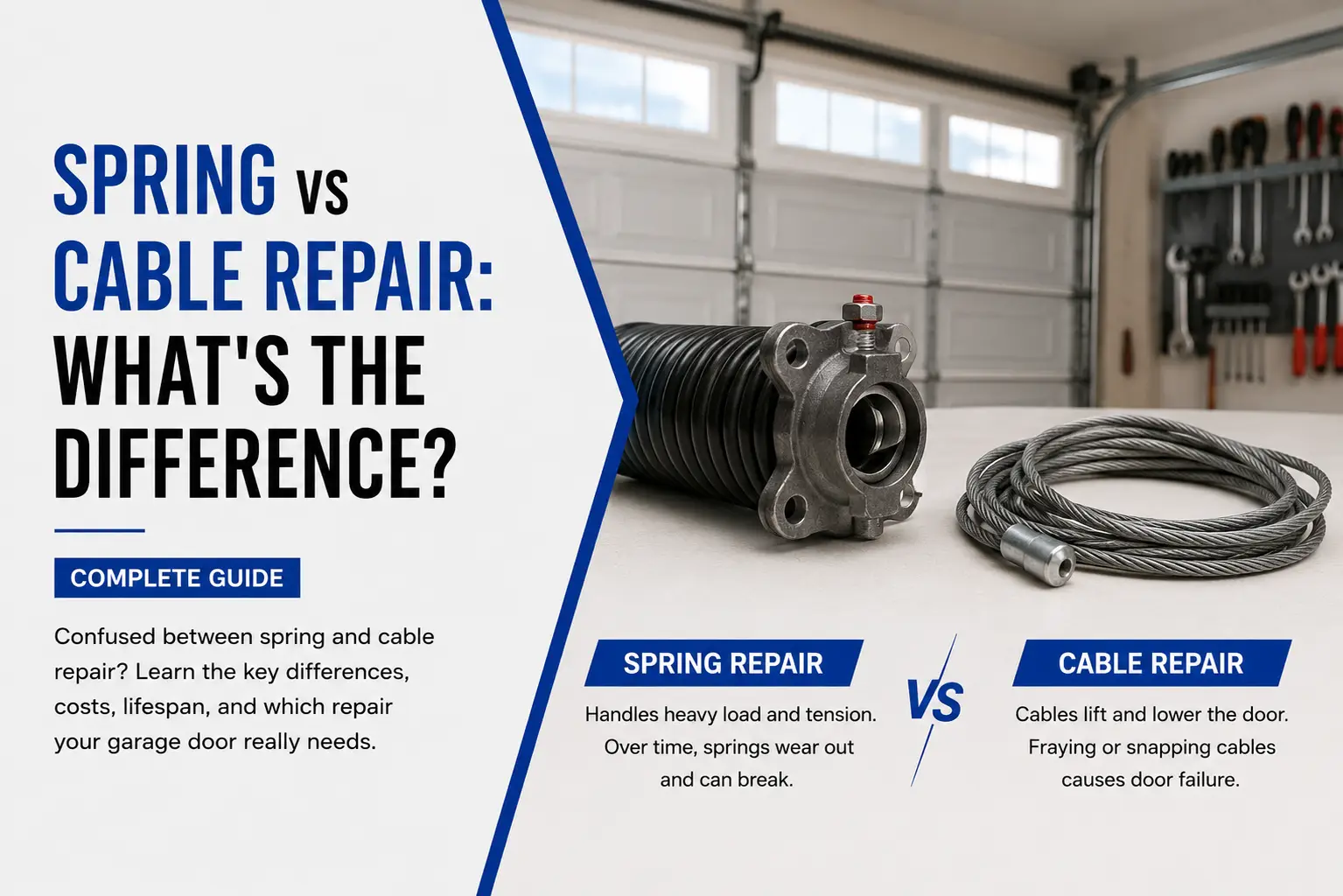

Spring and cable repair fix two different parts of your garage door system: springs store the tension that lifts the door’s weight, while cables guide and control the door’s movement along the tracks. Spring repair addresses lifting power, and cable repair addresses safe, controlled motion, so a technician needs to diagnose which part actually failed before starting work.
This guide breaks down exactly how garage door spring repair differs from garage door cable repair, what causes each to fail, and how WeFix Garage Door Repair helps Houston homeowners get the right fix the first time.
What Is Garage Door Spring Repair?
Garage door spring repair fixes or replaces the springs that counterbalance the weight of your garage door. Without working springs, a standard garage door can weigh 130 to 400 pounds, making it impossible to lift safely by hand or with a standard opener motor.
There are two main spring types:
- Torsion springs sit horizontally above the closed door and twist to store energy.
- Extension springs run along the horizontal tracks on either side of the door and stretch to store energy.
Both types wear out from repeated cycles of tension and release. Our guide on garage door spring repair vs. replacement explains which option fits different spring conditions.
What Is Garage Door Cable Repair?
Garage door cable repair fixes or replaces the steel cables that connect the springs to the bottom bracket of the door and guide it along the track during opening and closing. Cables work together with springs, but their job is entirely different: they carry the door’s movement safely, not the lifting tension itself.
Cables typically fray, stretch, or slip off their drum or pulley over time, especially with frequent daily use. A broken cable often causes the door to hang unevenly or drop suddenly on one side.
Why the Difference Between Spring and Cable Repair Matters
Getting the wrong diagnosis leads to wasted money and continued safety risk. A door with a broken spring but intact cables will feel extremely heavy and may not open at all, while a door with broken cables but working springs may open unevenly or the door could fall off track entirely.
Houston’s humidity and heat cycles add extra strain on garage door hardware year-round, accelerating rust on cables and metal fatigue on springs faster than in drier climates. Regular garage door maintenance services help catch these issues before they become emergency repairs. See our article on why regular garage door maintenance saves you time and money for more on this.
How to Tell Spring Problems From Cable Problems
Signs of a Broken Garage Door Spring
- A loud bang from the garage, often mistaken for a gunshot
- The door feels extremely heavy when lifted manually
- The opener struggles or stops partway through opening
- You can see a visible gap in the torsion spring above the door
- The door opens a few inches, then reverses or stalls
Signs of a Broken Garage Door Cable
- The door hangs crooked or at an angle
- A visible frayed or loose cable near the bottom bracket
- The door makes grinding or scraping noises
- One side of the door drops faster than the other
- The cable has slipped off the drum or pulley
Comparison Table: Spring Repair vs. Cable Repair
| Factor | Spring Repair | Cable Repair |
| Main function | Provides lifting force | Guides door movement and connects to springs |
| Common failure sign | Loud bang, door feels heavy | Door hangs crooked, frayed cable visible |
| Typical lifespan | 7-10 years or 10,000-15,000 cycles | 5-10 years, depending on use |
| Repair urgency | High, door may not open safely | High, door may fall or come off track |
| DIY safety risk | Very high, springs are under extreme tension | High, but generally lower than spring tension |
How Professional Spring and Cable Repair Works
- Safety shutdown. The technician disconnects the opener and secures the door before inspecting anything.
- Diagnosis. Springs, cables, drums, and pulleys are all inspected to confirm which component failed.
- Tension release. Any remaining spring tension is safely released using professional winding bars.
- Component replacement. Broken springs or cables are removed and replaced with correctly rated hardware.
- Balance test. The technician checks garage door balance adjustment to confirm even lifting on both sides.
- Full cycle test. The door is opened and closed multiple times to confirm smooth, quiet, safe operation.
This process mirrors a full garage door inspection guide, since spring and cable issues often reveal other wear on rollers, tracks, or the opener.
Why Spring and Cable Repair Should Never Be DIY
Garage door springs store enough tension to cause serious injury if handled without training and the right tools. A snapped cable under load can also whip and cause harm. Our article on DIY garage door repair explains which tasks are safe for homeowners and which ones require a professional garage door technician.
Common Mistakes to Avoid
- Replacing only one spring. Torsion springs are usually installed in pairs and wear at a similar rate. Replacing just one often leads to a second failure soon after.
- Ignoring frayed cables. A slightly frayed cable can snap without warning, causing the door to drop suddenly.
- Confusing a cable problem for an opener problem. A door that won’t open isn’t always an opener issue. Check our guide on garage door not opening causes and solutions before assuming it’s the motor.
- Skipping balance adjustment after repair. An unbalanced door puts extra strain on the opener and shortens the lifespan of new springs and cables.
- Hiring unqualified help. Review our comparison of handyman vs. professional garage door repair before choosing who works on your door.
Cost Factors for Spring and Cable Repair
Pricing depends on spring type, cable length, door size, and how many components need replacement.
- Spring type: Torsion springs generally cost more than extension springs due to installation complexity.
- Number of springs or cables: Replacing both springs or both cables costs more than a single-side repair.
- Door weight and size: Heavier, wider, or custom doors require higher-rated hardware.
- Emergency vs. scheduled service: Same day garage door repair may include a service call premium.
For detailed pricing guidance, see our garage door repair cost guide and garage door repair quote guide.
How to Choose the Right Repair Solution
Match the repair to the actual failed component, not just the symptom you’re seeing. If your door won’t budge and you hear a loud bang, that points to a broken spring. If the door hangs crooked or a cable is visibly frayed, that points to cable repair.
A qualified technician from WeFix Garage Door Repair inspects the entire system, not just the obvious symptom, since a failed cable can sometimes damage nearby rollers or tracks. If your door has completely stopped working, our guide on emergency garage door repairs explains what to do while you wait for help.
Frequently Asked Questions
What is the difference between spring and cable repair?
Spring repair fixes the component that lifts the door’s weight, while cable repair fixes the steel lines that guide the door and connect it to the springs. A broken spring makes the door too heavy to open, while a broken cable makes the door hang crooked or fall unevenly.
Can a broken cable cause a broken spring?
Yes, in some cases. When a cable snaps under load, the sudden shift in tension can put extra stress on the remaining spring, increasing the chance of a second failure. This is why a full inspection after any cable failure is important.
How long do garage door springs and cables last?
Garage door springs typically last 7 to 10 years or 10,000 to 15,000 open-close cycles, while cables generally last 5 to 10 years depending on use and maintenance. Humid climates like Houston can shorten this lifespan due to rust and metal fatigue.
Is it safe to repair a garage door spring myself?
No. Garage door springs hold extreme tension and can cause serious injury if released incorrectly. Professional garage door technicians use specialized winding bars and safety procedures to replace springs safely.
How much does spring and cable repair cost?
Cost depends on spring type, cable length, and how many components need replacement. Getting an accurate quote requires a professional inspection, since torsion springs, extension springs, and cable replacement all carry different pricing.
Final Thoughts
Spring and cable repair solve two different problems: springs provide lifting power, and cables provide safe, controlled movement. Knowing the difference helps you describe the issue accurately and avoid paying for the wrong repair.
WeFix Garage Door Repair provides professional residential and commercial garage door repair across Houston, including spring replacement, cable replacement, track repair, and same day garage door repair for urgent situations. Contact our team today to schedule a garage door safety inspection and get your door working safely again.